Sunday, 31 July 2011

Games as Heterotopias

Reading Michel Foucault's "Of Other Spaces" (Diacritics, Spring 1986) a lecture originally given in March 1967 and startlingly prescient of digital technologies and their potential for virtual spaces.

Foucault argues the concept of the heterotopia, a sort of anti utopia, a space simultaneously mythic and real defined by five principles.  So, heterotopias are capable of juxtaposing in a single space several real spaces that are in themselves incompatible (a theatrical stage, for example), are linked to slices in time - heterochronies, where traditional concepts of time break down, and a spaces detached from the mundane world, in some senses private and requiring of formal entry and exit.


These ideas (and I know I am far from original in thinking this) seem to perfectly frame the concept of a free-form game of landscape and memory, in which a virtual representation of the real world (detached, theatrical and demanding formal entry and exit) unites incongruent spaces and times in a single virtual space. Imagine exploring a virtual landscape in which fragments of time and past space litter the present world and you have the general idea. Such fractured worlds are in fact common ground in many games, recall Gordon Freeman's jolting journey through other spaces in the latter part of the original Half-life, and are the meat and drink of works such as Dear Esther and Korsakovia. In fact in many ways all games that strive to represent the real world digitally are hetrotopias of a sort (Assassin's Creed's time and place jumping narrative is another example).  

I like this concept of the breakdown of formal space and time into something more mysterious and demanding greater engagement to comprehend, as a structure it has much to ponder on in designing mythic-real game spaces for exploring heritage.

Wednesday, 27 July 2011

Lasers, Landscape and Muddy Boots

I'm in the process of writing a presentation on the potential applications for immersive visualisation of airborne lidar for the upcoming symposium on Technological Advances in Landscape and Heritage Management Recording to be held at University College Dublin on 12th August.

Among a plethora of papers on technical aspects of airborne and terrestrial laser scanning I'm trying to get across a point about the deficiencies of conventional visualization of high density landscape data.  Methods of survey have developed dramatically in the recent past with the advent of new digital survey techniques, global positioning airborne and terrestrial laser scanning and the volume of data collected to record monuments and landscapes may now be vast  Growth in data quality and volume has been accompanied by a reluctant theoretical debate, largely about method and meaning in the practice of survey.  The visualisation of survey results has tended to remain rooted in traditional approaches, albeit facilitated by new digital media.  The ability of modern digital survey to engage with others areas of archaeological debate, for example discussions of sense of place, meaning and interpretation in landscape, as embodied by for example the phenomenological approach to landscape has largely been ignored as it is poorly addressed using conventional static visualisation techniques. 


So game software offers the potential to engage with data not just through a cognitive analytical process, but experientially, by inhabiting a virtual rendition of the surveyed landscape.  And once rendered this hyperreal landscape can be populated with all manner of data, from surveyed facets of monument and landscaape morphology, to the vestiges of historical documentation and the impressions of viewers. What comes to mind is the concept of thirdspace, coined by urban geographer Edward Soja - 

“everything comes together… subjectivity and objectivity, the abstract and the concrete, the real and the imagined, the knowable and the unimaginable, the repetitive and the differential, structure and agency, mind and body, consciousness and the unconscious, the disciplined and the transdisciplinary, everyday life and unending history.”

But that might be going a little too far for the present...


Thursday, 26 May 2011

CryENGINE 3

Very excited by the arrival of our new Educational License for the CryENGINE 3 SDK from CryTek.


Some work to do in setting up a license server for our research community here at Birmingham, but personally I'm looking forward to exploring the incredible potential of this software for landscape rendering, and the technical potential of outputting standalone content for web deployment and stereoscopic 3D - particularly on our Mechdyne  PowerWall.

Tuesday, 3 May 2011

Tale of Tales

Recently I have been enjoying two wonderfully evocative games produced by the duo Auriea Harvey and Michaël Samyn, aka Tale of Tales.

The Graveyard is a simple visual meditation on approaching death, you guide an old woman in her short walk across a graveyard to a seat by the chapel, where in a scripted scene, she reflects on life, death and those she has seen buried.


This rather lovely little game, bravely rendered in monochrome, is both thought provoking and visually delightful. It pays replaying simply to enjoy the visual richness of the landscape.

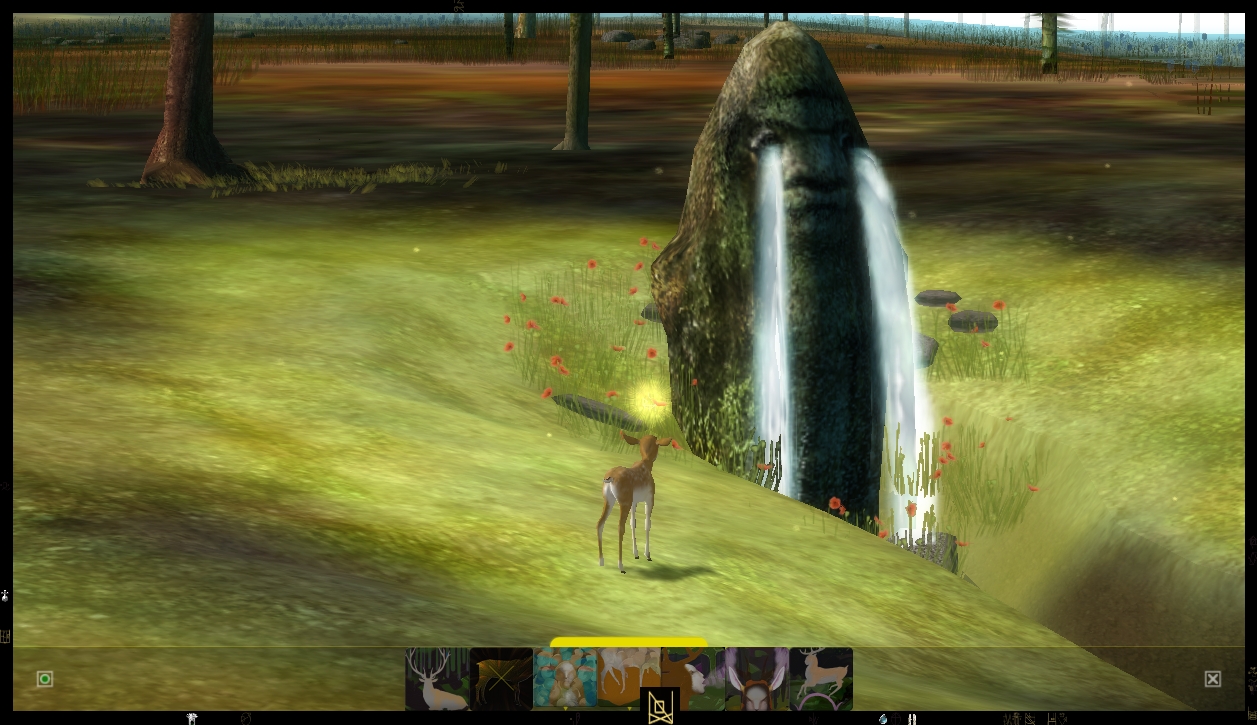
Rather different, but equally attractive, is The Endless Forest.  In this unworldly game, set in a forest familiar in visual style to players of The Path, players adopt the avatar of a deer, and wander through an endless richly detailed forest, encountering avatars of other internet players.


The open ended game play is absorbing, you are drawn into a world in which you move freely in all directions, encountering landscape, architecture, artifacts and other players with little guidance as to how to act.  Game play is an experience of learning to live the game world, guided by simple image icons that change dynamically to access appropriate actions.  I am still learning to enjoy and explore the world of the Forest, and the game system rewards long-term play with a developing avatar and new action options.

So, it strikes me that these simple, open games, embody much of what I would like to see in the adoption of game technology for engaging with heritage.  Imagine freedom from the scripted path of traditional games, a freedom to explore and encounter.  Perhaps even a stripping of the strict rules of linear time, so that one encounters echoes of the entire past in a rendering of the present landscape.  I see such games as released from the requirements of strict historical accuracy, more a fusion of history, drama and art in which a combination of game play, visual richness and evocative content draw players to explore place, time and space and in so doing create their own meanings.